Wednesday, 7 February 2018

Clint Eastwood and Real-Life Heroes from Paris Train Attack on Jimmy Kimmel


Clint looked in good spirits when he appeared alongside his stars and real life heroes from his new movie The 15:17 to Paris on Jimmy Kimmel Live! Monday night.
The civilian trio – Anthony Sadler, Oregon National Guardsman Alek Skarlatos and U.S. Air Force Airman First Class Spencer Stone – had never acted before. Sadler spoke about what it was like to do so not just for the first time, but with a director like Eastwood.
"The dynamic at first, he's such an icon, so you're looking for a 'Good job,' and I look over at him after my first scene and his face is really neutral, and I'm like, 'He hated it!,'" Sadler recalled. "But then I realized that his mode is to just move on and that's a good job in and of itself. The first time he told me 'Good job,' it was like a proud dad moment."
             
Along with Stone, Skarlatos and Sadler, The 15:17 to Paris features other passengers who were actually on the 2015 train, including Mark Moogalian, who tackled the gunman and was shot in the back. Eastwood said he was somewhat concerned about asking people to relive and recreate a potentially traumatic experience, saying, "I thought maybe it would be a bad memory or something, but it acted as a catharsis for some people, especially Mark because he got shot. He felt like it was getting rid of something." 
My Thanks to Steve Saragossi for sending this in.

Tuesday, 6 February 2018

The 15:17 to Paris premiere in Los Angeles

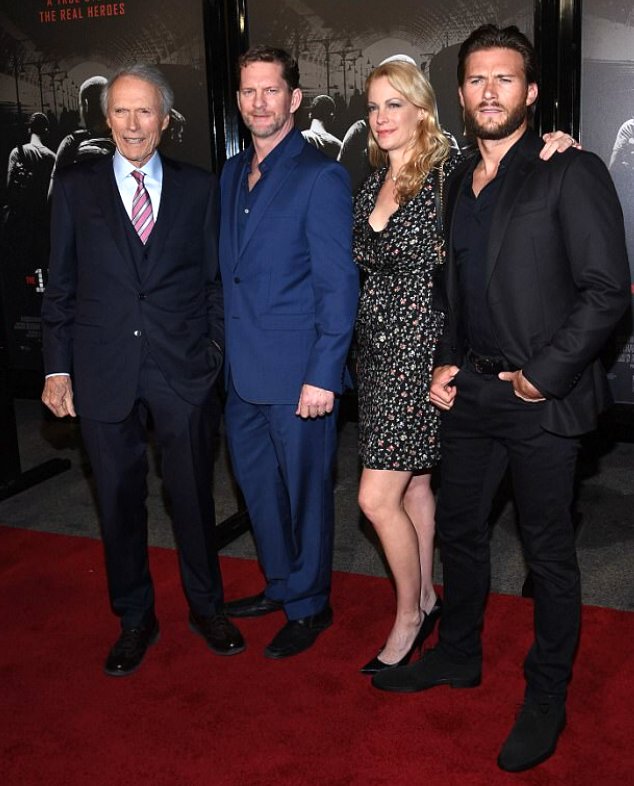
Clint Eastwood joins six of his children at The 15:17 To Paris premiere in Los Angeles - Story by Sameer Suri for DAILYMAIL.COM, 6th February 2018. 
Clint Eastwood beamed at the Los Angeles premiere of his latest film The 15:17 To Paris, which is about 2015's foiled jihadist attack on a Thalys train. The 87-year-old director was joined some of his children - namely, Alison, Scott, Francesca, Morgan and Kathryn Eastwood.  Another red carpet stomper at Monday's premiere - held at Warner Bros. Studios - was Arnold Schwarzenegger, who like Clint and his children is not in the film.

Clint cut a dapper figure in a navy three-piece suit, complementing the look with a powder blue dress shirt and a blue and pink striped tie. The director of The 15:17 To Paris was joined at its premiere by his platinum blonde girlfriend Christina Sandera, who is 33 years his junior. Meanwhile, the hunky Scott, 31, modeled a glinting dark suit over a midnight blue dress shirt, going without a tie and leaving his top button undone over his chest. Balancing on black stilettos, 45-year-old Alison, an actress and fashion designer, flashed a bit of cleavage in a floral dress hemmed just above the knee.
Stacy, is the husband of Clint's daughter, Alison, and looked chic in a blue suit he wore over a dress shirt in exactly the same shade. Actress Francesca, 24, wore a sleeveless black cocktail dress with scarlet heels and massive hoop earrings, and on occasion had flung a grey coat over her shoulders. Modelling black stilettos of her own, 21-year-old actress Morgan Eastwood elegantly clashed an immaculate white blazer against a black mini-dress.

Writer and actress Kathryn, 29, wore a buttoned-up collared striped black and white dress, complementing her high-heeled low-top boots. In one photograph, she planted a kiss on her aged father's cheek.

The 15:17 To Paris is based on the real story of Alek Skarlatos, Spencer Stone and Anthony Sadler, three Americans who impeded a 2015 Islamist terrorist attack on a Thalys train that was carrying them from Amsterdam to Paris.


This new film is based on the memoir The The 15:17 To Paris: The True Story Of A Terrorist, A Train, And Three American Heroes - which Alek, Spencer and Anthony co-wrote with one Jeffrey E. Stern.

Alek and Spencer were both U.S. military men at the time of the attack, and along with Anthony and Chris, they were garlanded by then French President François Hollande as Chevaliers De La Légion D'Honneur. All three of them have played themselves in Clint's new film about them, and they posed with their director at Monday evening's premiere. Clint was also snapped with child actors William Jennings, Paul Mikel-Williams and Bryce Gheisar - who play Spencer, Anthony and Alek respectively as children.
Sinqua Walls, another of the film's stars, exuded chic in a purplish brown suit he wore over a pristine white dress shirt and an Oxford blue tie. He got in a bit of posing with his director as well, the pair of them grinning broadly as they stood together for the camera. Meanwhile, Arnold - the action movie star and ex-Governor of California - wore a charcoal suit over a checked blue dress shirt with no tie. Teaming an elaborately patterned pair of dress shoes with a belt that featured a massive buckle, he posed with a hand shoved into his pocket. The 70-year-old had arrived at the premiere with his black-clad current girlfriend Heather Milligan, a blonde physical therapist who is in her 40s. While at the premiere, the couple could be glimpsed chatting with Scott. Jenna Fischer, who plays Alek's mother Heidi, draped her svelte frame in a midnight blue skirt that featured a thigh-slit up the front and centre. Winding a gleaming Chanel belt about her svelte waistline, the 43-year-old wore a floral strapless top with a lace-trimmed neckline.
While at the premiere, she stood for the photos alongside director Lee Kirk, who is her second and current husband and by whom she has two children. Franco-German actress Jeanne Goursaud, who plays a character called Lea in the film, stunned in a cleavage-baring crimson trouser suit. The 21-year-old slicked her blonde hair back behind her head, accessorizing with a print clutch and wearing stilettos with red, white and blue straps. Actress Briana Evigan, who is not in this movie, nonetheless turned up to the premiere in a robe-like rust-toned dress with a plunging neckline. A white purse slung over her left shoulder, she posed alongside actor Josh Kelly, who per IMDb is her co-star in the upcoming thriller film Already Married. Kevin Sorbo, who is also not in the film, was photographed at the premiere alongside his wife Sam Sorbo. They rang in their 20th wedding anniversary last month. Wearing a black suit with a white dress shirt, Lone Survivor actor Emile Hirsch posed at the premiere with his long brown hair falling free over his shoulders.

Actor Ronn Moss, 65, and his model wife Devin DeVasquez, 54, who are not in The 15:17 to Paris, also grinned for the cameras at the premiere. So too did Thomas Lennon - who is indeed in the premiering movie, playing a character the film's IMDb page identifies only as 'School Principal.' 


Actor Tom Skerritt (below), who like Clint is now in his 80s, is not in the film but did pose up at the premiere for The 15:17 to Paris, which will open in movie theatres Friday. 

The friends who foiled a gunman - and are now playing themselves in a Clint Eastwood movie


The friends who foiled a gunman - and are now playing themselves in a Clint Eastwood movie by Emine Saner, The Guardian.
Two years ago, on a French train, three young Americans took down a man who was armed with an AK-47 and 300 rounds of ammunition. Now, they’re film stars. Where will their extraordinary lives go next?
The only moment during filming that felt truly like a flashback, says Spencer Stone, was when he was crouching by the bleeding man on the floor of the train carriage, his finger pressed into his neck wound to try to stop the blood. “We’re saying the same things we said to each other, we’re on the train, we’re wearing the same clothes, they recreated our injuries so we’re all covered in blood again,” says Stone. “There is the insane amount of blood that I remember.”
Like Stone, the man on the floor is not an actor, but Mark Moogalian, the actual person who lived the events of 21 August 2015, when a gunman, armed with weapons including an AK-47 and almost 300 rounds of ammunition, allegedly attempted to commit a terrorist atrocity. “I just completely forgot anyone was there,” says Stone, “and once they said: ‘Cut’, I was like: ‘Oh, there are other people [here]’ and I looked up and Clint Eastwood was standing in front of us looking at the monitor.” He had a strange expression on his face, remembers Stone, which he can’t really describe; so did the crew.
Stone locked eyes with his friend Anthony Sadler, who was a short way away on the train carriage. “I kind of gave him a look like, ‘That was it’, for the first and only time during shooting we might as well have all been on the train in 2015 again,” remembers Sadler. “Everybody felt that, even the crew. It felt as real as it gets. Basically, they saw what happened in real time.”
Two and a half years ago, three young Americans – Stone, then 22, Sadler, 23, and their friend Alek Skarlatos, 22 – were on a tour of Europe. Friends since school, it was a reunion of sorts (Skarlatos and Sadler hadn’t seen each other for some years). On a train from Amsterdam to Paris, the three – along with British businessman Chris Norman, and Moogalian, who apprehended the man first – stopped an alleged attempted terrorist attack. They were soon on their way home to Sacramento, California, but not before picking up the Légion d’honneur, France’s highest decoration. Today, they are back in the city, in a grand hotel suite, lounging, legs on tables, to promote the film The 15:17 from Paris, directed by Eastwood, in which they play themselves.
The atmosphere is slightly hysterical – the three are hyped-up on jetlag, attention, sports drinks and the path that the train journey has taken them on. Stone was a staff sergeant in the US air force; Skarlatos was a specialist in the Oregon national guard; Sadler was a kinesiology student at the University of California. Now, all three would like to be movie stars.
“We enjoyed it so much and we had such a great opportunity working with Mr Eastwood that we have to at least give it a shot,” says Skarlatos. “I don’t know if it will work out or not.” He has just taken acting classes; Stone is about to. It has been a unique experiment by modern Hollywood standards, if not historic (the former US soldier Audie Murphy played himself in To Hell and Back in 1955, but he had already been an actor for a number of years by then), and all three do a remarkable job. It’s incredibly moving when the real footage of them, young and a bit bewildered, wearing hastily borrowed clothes at the Légion d’honneur ceremony, is spliced in.

They met Eastwood when he presented them with an award in 2016. Backstage, joking, they asked if he would be interested in directing a film of their story. They had a book coming out, and he asked them to send it to him. They did, and they received a call soon afterwards to say Eastwood wanted to film it. Three weeks before shooting started, he called them to Los Angeles.
“They’d been casting the movie for a while so we assumed we were going down there to meet the actors who were playing us and he basically said: ‘Do you guys think you could do it again for us?’” says Skarlatos. “We thought he meant to re-enact it to show the actors how to do the fight scene. He rephrased it because he could tell we didn’t understand. We were like, ‘Are you asking us to be in the movie?’ And he said: ‘Yeah.’ The second he left the room the reality of the situation set in – he’s taking a huge risk on us, I don’t know if we’ll be able to pull it off.”
They asked for 24 hours to think about it. Were any of them not keen? “I was but only because of the fact that these things just don’t happen, people don’t play themselves,” says Sadler. “I was like, actors can do it and it will be a way better movie. We were all on the phone and Spencer said: ‘Twenty years from now, are you going to say you could have been in your own movie directed by Clint Eastwood but you told him no?’ That was enough for me.”
About the sum total of their acting experience belonged to Skarlatos, who had been in school and church plays. “He played, like, a tree,” says Stone and they all collapse into laughter. “I was an alligator,” says Skarlatos. 
Stone puts on a pedantic voice, mocking his friend: “For your information, I was a crocodile.” Skarlatos, mock-frustrated now, while Sadler has doubled up in laughter on the sofa: “I was an alligator, they’re different!” Did they have acting lessons? “Doubt started to creep in, and we were like: ‘Hey, Mr Eastwood, thanks for the opportunity, but we feel like we’re going to need some acting classes,’” says Stone. “He pretty much just said no because he didn’t want it to look like we were acting, he wanted us to be natural and be ourselves and do things exactly how it happened.”
They all admit to nerves and feeling self-conscious on the first day of filming. “Not having known him too well, I’m looking for, I don’t know, a standing ovation after each scene,” says Sadler. “I don’t know what I’m looking for, just any reaction and he doesn’t give reactions like that, he doesn’t say if it’s good or bad, so we all had to learn through the process what he liked and didn’t like. If he was moving on in the scene it was like, OK, he got it, he was happy with our performance.”
Skarlatos, seeing the huge number of people who make up a film shoot, suddenly felt the pressure to do a good job. Stone says he remembers going through “a crash-and-burn-type feeling. All your insecurities are firing on all cylinders. It was just something I felt I had to get over. I almost feel like playing someone else would be a little easier.” Sadler says: “I feel like we all had at least one day that we were like, ‘Man, I’m kind of messing this up.’”
What did Eastwood want from them? “He wanted us to be ourselves,” says Stone. “He kept it really simple with us because we hadn’t acted before. That’s his style really anyway, he doesn’t over-direct. He was basically saying: ‘This only happened two years ago, you’re with your two best friends, if you’re having a beer, have a beer and talk to your friend.’ And don’t worry about the script, the camera, just enjoy being with your friends, and we’ll capture it.”
It felt natural, doing it with friends, says Skarlatos, having “the same conversations we would normally have. Even if the acting is not so good, it’s definitely true to who we are as people. We watched the movie with our friends and family, and they could tell it was us on screen, it’s not like we were being fake or trying to be somebody else for the camera.”
It must have been a surreal experience. “Very surreal,” says Skarlatos. “Wearing the same clothes, doing the same stuff. It was only two years ago so we’ve remembered almost everything. We used a lot of things we actually said in real life.”
“For us,” says Sadler, “it’s special because we’ll be able to look back on it and be like, that is truly us in 2015 and that time in our lives.” For most people, it would perhaps be a time they would rather not remember – or relive. In the train carriage, Stone was dozing with headphones on when a member of the train staff in uniform sprinted past him. 
The door to the carriage slid open and he says Moroccan national Ayoub el-Khazzani, then 25, entered, carrying an AK-47 and a backpack on his chest packed with – they would later find out – hundreds of rounds of ammunition. By then Stone was crouched between the seats. A split-second later, he was up – 6ft 3in and heavily built – and charged at el-Khazzani down the aisle. He knew he was about to get peppered with bullets, he writes in his book, but thought maybe it would delay the gunman enough to give the others a chance.
“In the moment I wasn’t thinking about much,” says Stone, “but looking back and being able to evaluate what I saw, it was really just because we had nowhere to go. We were on a moving train in the middle of the countryside, he’s got an automatic weapon and it was either just sit there and wait for him to walk up and shoot us, or try and do something.” El-Khazzani took aim, but miraculously the gun jammed. They fell to the floor and the fight began, soon joined by Skarlatos, during which the gunman would bring out a pistol and attempt to shoot Stone with that, then bring out a knife. Stone suffered slashes to the back of his neck and his thumb was nearly severed. He managed to get el-Khazzani in a chokehold, and eventually the Moroccan passed out.
Once he had been subdued, and while Skarlatos and the British man, Chris Norman, were restraining him using neckties, Stone went over to Moogalian, who had been shot in the neck, and staunched the blood loss. About half an hour later, the train pulled into the station at Arras and police and paramedics took over.
What was it like to relive that violent scene? “It was a lot of fun, really,” says Skarlatos, although he says it was “surreal and strange. We were wearing the same clothes, with the same people [including Moogalian, his wife, many of the train staff]. We’re on a train. Ray [Corasani, the actor playing el-Khazzani] looked very much like the [alleged] terrorist.” It wasn’t, he says, “a traumatic or negative thing for us. But seeing the same things again, it made it very easy to feel the same emotions and feel scared, or angry or [experience that] adrenaline rush.”
Nobody died, he points out. Moogalian survived, and Skarlatos doesn’t have to live with what it might be like to have killed el-Khazzani (they say he was trying to stab Stone, who was holding him from behind, and Skarlatos put the gunman’s AK-47 to his head and pulled the trigger, but it didn’t fire; had it done, it would likely have killed Stone as well).
Was it cathartic? They all say it was. “We worked through the same things, and we learned a lot about [el-Khazzani’s] life we didn’t know,” says Skarlatos. “It was nice to tell the story once and for all, because we’re doing it in a Clint Eastwood movie, which is about the biggest [way] you can tell anything.”
“We’re proud of this but we have the rest of our lives to live,” says Sadler. “This is kind of like a stamp on the chapter, and we can hopefully move on.”

They say they really only think about the attack when they are asked about it in interviews. “It’s not something that rules our thoughts,” says Stone. “We don’t let it cripple us.” Do they dwell on the what-ifs? What if they had run instead of fought? What if the alleged terrorist – el-Khazzani is awaiting trial in France and denies terrorism charges – had managed to kill one of them, and gone on to shoot many more? “I do,” says Sadler. “You can’t help it, especially when you see a new headline and it’s always a number, a tally: 50 people dead, five people dead. How easy we could have been, should have been, one of those numbers.”
Would they have done anything differently? “No, I think everything worked out the best way it could,” says Stone. “Even when we consider the option of what if we did decide to run, even if we would have made it out alive, we couldn’t live with ourselves knowing we had the opportunity to do something and we chose to go the other way. I wouldn’t be able to enjoy my life with that decision. I would rather have died.”
The film makes a big play about how these young men are heading towards this destiny. “We didn’t say it exactly like that, but it was based off real conversations that we had,” says Stone. All three have a strong religious faith (they met at a Christian school, were regular churchgoers and Sadler’s father is a pastor) and have said they believe they were guided and protected by God on that day. “At the time we didn’t realise it,” says Skarlatos, “but looking back, it’s kind of like everything we did in our lives did prepare us for the train attack in some way.”
The film is selling itself as ordinary people doing something extraordinary, but that’s an over-optimistic reading of the event – after all, it was Stone’s jujitsu training and battlefield medical knowledge that subdued the gunman and saved Moogalian’s life; it was Skarlatos’s military training that allowed him to attempt to use, then make safe, the guns. But their bravery and willingness for self-sacrifice is nonetheless inspiring.
The attack has changed their lives – the awards, the invitation to meet Barack Obama at the White House, the chatshows, the potential movie careers. How has it changed them? “It makes me grateful for every day that we have because we all know that we could have died that day,” says Skarlatos. Sadler says the same, adding, “You survive something like that, so you don’t find yourself wasting time over that small stuff any more.” Stone says it has changed him “in that I live day by day at this point. People ask me: ‘What are you doing with your life? What’s your plan?’ I’m like, ‘I don’t know.’ I feel like it’s a gift to be in the mindset I’m in, living day by day and not thinking too far into the future. Because if there’s anything we’ve learned from this, it’s that you never know.”

•The 15:17 to Paris is released on 8 February in Australia, and 9 February in the UK and US

Collecting Clint in print # 1 Clint Eastwood Film Portraits No5 (French)

After a brief conversation about this rare French publication last night, I thought it was about time to cover the publications and books on Clint. It’s not a new idea. I planned on originally creating one long section on the books to tie in with our 10th Anniversary last year. However, time got the better of me and I just didn’t get around to finishing it in time. So I thought it would be better to approach them on a one-to-one basis. It also means I can do it as time allows and they make for good little posts in between other stories and news pieces. Some publications are now very rare, such as this first book. It was impossible to find a picture of it on the web; therefore I have had to take a scan of the book.

Clint Eastwood Film Portraits No5 (French) was a series of books from France. The series also covered stars such as Chalton Heston, Charles Bronson and Paul Newman. It was approx. A4 (8.3 x 11.7) in size and consisted of 50 pages. The Eastwood edition has a date inside as November – December 1978. There was a good spread of full page and half page bw photos with a centrefold of Eastwood as Josey Wales. It’s a very hard publication to find these days, I don’t recall ever seeing one on Ebay, and imagine it would command quite a high price on today’s market.
Below: Front and back covers
                

Monday, 5 February 2018

Clint Eastwood Interview EPK for The 15:17 To Paris

Here is the Clint Eastwood interview sections from the Electronic Press Kit for The 15:17 to Paris.
           

Sunday, 4 February 2018

The Witches (Le Streghe) 1967 Blu-ray release from Arrow Academy


In the mid-sixties, famed producer Dino De Laurentiis brought together the talents of five famed Italian directors for an anthology film. Their brief was simple: to direct an episode in which Silvana Mangano (Bitter Rice, Ludwig) plays a witch.

Luchino Visconti (Ossessione, Death in Venice) and screenwriter Cesare Zavattini (Bicycle Thieves) open the film with The Witch Burned Alive, about a famous actress and a drunken evening that leads to unpleasant revelations. Civic Sense is a lightly comic interlude from Mauro Bolognini (The Lady of the Camelias) with a dark conclusion, and The Earth as Seen from the Moon sees Italian comedy legend Totò team up with Pier Paolo Pasolini (Theorem) for the first time for a tale of matrimony and a red-headed father and son.
Franco Rosso (The Woman in the Painting) concocts a story of revenge in The Sicilian’s Wife, while Vittorio De Sica (Shoeshine) casts Clint Eastwood as Mangano’s estranged husband in An Evening like the others, concluding The Witches with a stunning homage to Italian comic books.

According to Michael Munn in his 1992 book, Clint Eastwood: Hollywood's Loner ‘Le Streghe was never released outside of Europe as United Artists bought the film when Clint Eastwood's career began to take off. United Artists decided not to release it in theatres but instead kept it in their library vault to prevent its viewing’.

I've never believed that to be necessarily true, as I always come back to the same question. Why did United Artists have a 1 sheet poster produced if their only intention was to bury the film? I think United Artists did release The Witches, around 1969 and only after Eastwood had established himself through the success of the Dollar trilogy and once Hang em high had been released. The Witches remains a very strange movie, there's no doubt about it. It’s very eclectic and very arthouse in its style. But it's also a fabulous chance of obtaining this Eastwood oddity, which in some ways is quite amusing looking back at it now.

Arrow has done a fabulous job on the presentation. Picture detail is very nice, especially in comparison to the MGM/UA manufactured on demand DVD-R, which was the only other previous way of obtaining this movie. For starters, there’s a brand new 2K restoration from original film elements produced by Arrow Films and exclusively for this release. Audio is presented in its original Italian mono (uncompressed LPCM). Bonus material includes a brand-new audio commentary by film critic and novelist Tim Lucas. The complete English-language version of The Witches, on home video for the first time in any format, presented in High Definition and with optional English subtitles for the deaf and hard-of-hearing And, in line with Arrow’s usual policy, there’s a reversible sleeve option featuring original and newly commissioned artwork by Graham Humphreys. I hasten to add, despite a rather nice example of ‘new’ artwork; mine has already been reversed to display the original U.S. pink artwork. For its first run, there is also a 32 page illustrated collector’s booklet featuring new writing on the film by Pasquale Iannone and Kat Ellinger. There is also a postcard featuring the U.S. poster artwork.
Well worth grabbing and adding to your collection, especially for completest reasons.
Region Code: B, Running Time: 121 mins, Number of Discs: 1, Aspect Ratio: 1.66:1, Colour
Check it out at Arrow here

Saturday, 3 February 2018

Clint Eastwood's Cinema of Trauma: Essays on PTSD in the Director's Films


Clint Eastwood's Cinema of Trauma: Essays on PTSD in the Director's Films may not at first be the type of book that leaps out at the casual fan. However, for those who perhaps seek to examine Eastwood’s characters more deeply and perhaps from a different perspective, this collection of extremely well written essays delivers both a fascinating and revealing insight. The 10 essays in this volume examine posttraumatic stress disorder in films such as: The Outlaw Josey Wales, The Gauntlet, Unforgiven, Midnight in the Garden of Good and Evil, Changeling, In the Line of Fire, Absolute Power, Blood Work, Vanessa in the Garden, Mystic River, Flags of Our Fathers, Letters from Iwo Jima, Gran Torino, Invictus, American Sniper, and Sully.

It is perhaps important to first overcome any pre-conceived expectations or apprehensions that this book (edited by Charles R. Hamilton and Allen H. Redmon) is simply going to be ‘too deep’ or ‘heavy’ in its context. Naturally, PTSD is a serious matter, and its symptoms such as stress, fear, isolation, nightmares and guilt are far from simple to ignore or in deed overcome. But, it is in the use of Eastwood’s characters, people that we have come to know or at least recognise and placing them alongside the subject matter which works so well. We, as the reader can firstly identify the character and therefore apply and associate the subject matter more clearly and directly. PTSD may be a complex issue, but the text is presented in such a way that is simple enough to comprehend. I also found the book to be rather liberal in it breadth, often by identifying wider flaws in certain characters. For instance, Andrew Grossman’s essay ‘Feminism and Pacifist Spectacle in The Gauntlet’ is an extremely enjoyable read. It strips back the characters, revealing issues of masculinity, feminism, and the ‘unshackling of Eastwood’s dim-witted cop’ by an ‘enlightened woman’ which all makes for fascinating reading, and is more of a character study. However, it’s an element which only adds to the book’s overall strength.

The deeper aspects of PTSD are of course examined throughout its pages, but always presented in an easy-to-read and far from complex fashion. Allen H. Redmon’s ‘Projecting Recovery in American Sniper and Sully’ provides a thought-provoking insight, with each film’s focus on trauma, and their associated ‘complexities and moral dilemmas’. It compares and contrasts both films and the psychological impact of making critical decisions during traumatic events - the choices taken, the consequences of those choices and how to live with them.

The book is a wonderful read, with seemingly something new to be learnt from each of its 192 pages. The book was published in October 2017 and I would strongly recommend it, especially if you enjoy examining what exists beyond the narrative of Eastwood’s characters. It certainly offers a refreshing perspective and a welcome departure from the much repeated and formulated style of books on Eastwood. 
My sincere thanks to Allen H. Redmon for sending me this book – it deserves every success.

Publisher: McFarland & Co Inc, Product Dimensions: 15.2 x 1.3 x 22.9 cm
Below: links for U.K. and U.S.
For UK press here
For US press here