Friday, 15 May 2009

Clint Autographs: True examples

A friend of this site, Alex had written to me recently in regards to finding a genuine Eastwood autograph. While I cannot really suggest a 'route' in obtaining such a signature or in fact whom to trust in terms of sellers, I never really rested until I finally got to meet the man in person, and on that occasion Clint kindly signed 2 photos for me, one of which is dedicated to me and the other of which is just a signature. What I can do is reproduce the autograph here, if only in order to show what the genuine article looks like, circa 2004. Clint's autograph has of course changed throughout the years, like most people's do. To illustrate this I will also show a really early example of his signature, which again is a genuine example.

Above: An example of Clint's signature from the 1950's
Below: Clint's Autograph circa 2004, much more liberal and flowing in style.

Below: Here is a close up of the above autograph, for reasons of closer examination, I have left the HTML code of this scan unedited, so by clicking on the image will allow you to see the signature in larger detail in the hope that it will help you in your search.

I must stress though, it's a really thin line, even looking at my 2 autographs, which were signed within minutes of each other, there is still a distinct difference in the signing of his name, which means of course that even genuine signatures on the open market can differ from the above example and as a result, leaves it open to exploit. I guess the only way to obtain an autograph in the safe knowledge that it is in deed genuine, is to have it signed in front of you, it can be a long long wait, but it's absolutely worth it in the end. Never give up...

Thursday, 7 May 2009

Clint Interview: Focus on his land and properties, past and present

This Eastwood interview given to John Sammon for Today's Woman in 2007 provides a fascinating insight into Clint's early life and more specifically the homes, property and land owned by the actor, past and present. It's rather unique in that it barely touches upon Eastwood the actor, and, as a result, makes for a highly original and very interesting piece. The original source piece came without pictures. I have added these pictures below, just to make the interview 'look' a little more appealing on the eye.
 
I did an interview with actor Clint Eastwood. Eastwood is a worldwide celebrity, who rarely grants interviews. He graciously consented to talk about his early career, golf, including the annual U.S. Open golf tournament, his Mission Ranch development, and the frustrations of water and politics in his hometown of Carmel.

Clint Eastwood, actor, producer and Carmel’s former mayor - has been involved in the game of golf for nearly five decades. Eastwood relates his feelings about golf and his attitude toward a few other subjects. Here are the questions and Eastwood’s responses.

Question. Mr. Eastwood. Let’s begin with some background. What was your childhood like?

Answer. I was born in San Francisco, but raised mostly in Oakland. My family moved a lot, and I lived in places like Redding and Spokane in Washington and Sacramento, and Pacific Palisades in California. During the World War II years, my dad worked for Bethlehem Steel in Oakland. I attended Glenview Grammar School. As a kid, I earned a little money selling Liberty and Colliers magazines. Both of these are out of print now. Every magazine I ever worked for went out of print. Then I took a job with the Oakland Tribune, a paper route.

After the war, my father went to work for California Container, a corrugated box company. Later on, Dad was transferred to Seattle, where he became a plant manager. I graduated from high school and joined my parents up there for a while. I was trying to get into Seattle University on a music program, but I applied too late. I was drafted into the U.S. Army at the time of the Korean War, 1951. I came to Fort Ord. That’s how I got used to the Carmel area. I got to spend time in Monterey, Carmel, Pebble Beach and Salinas.

I even used to come to Mission Ranch when I was a soldier earning $75 a month.

Question. Did you dream that one day you would own Mission Ranch?

Answer. No. Back then, I didn’t plan on owning too much of anything. After I got out of the service, I went to Los Angeles where I attended Los Angeles City College, studying business administration. I started taking acting classes in the evening. After I landed a steady job on Rawhide (a 1950s TV western), I came up to the Monterey Peninsula and bought a little house across from the Monterey Peninsula Country Club. A tiny house with all the furniture inside. I’d been coming up periodically at that time, and stayed wherever I could. I loved that house. It was the first home I ever owned. I paid $20,000, and later sold it for $25,000.

Question. When was the first time you played golf at Pebble Beach?

Answer. I used to play over in Pacific Grove where there was a nine hole course. When a friend returned from Korea, we celebrated by playing Pebble. It was overwhelming, a much more difficult course than Pacific Grove, much longer. But Pebble was such a beautiful layout. You knew you were playing on a first-class course. I was 21 years old and I wasn’t very good. My friend and I just went out and tried to hit the ball as hard as we could. The ball would go in a lot of different directions. But we had a good time.

Later, I traipsed over the courses during the Bing Crosby Pro-Am, so I knew what they looked like. I didn’t play too much after that. A lot of years, I’d play once a year, or not at all, because I was busy trying to get a career going. It never gave me much of a chance to be a player.

Question. You bought the Mission Ranch in 1986. One of the proposals at the time was to turn the site into condominiums?

 Answer. Yes. The Ranch was approved to be torn down in order to put in sixty-six condos. There were a bunch of owners at the time, guys and their ex-wives, their girlfriends…you name it. In fact, fourteen people had to sign off when I bought this place. They had to meet a lot of conditions to put up these condos, so I offered them some dough. They agreed on a price, and I had to go and get these fourteen signatures, and sort them all out. Mission Ranch had once been a farm and a dairy. One of the buildings, the bunkhouse, dates back to 1852.

The floors had to be replaced. We just went through the place piece by piece, redoing everything. Like the barn for instance. They used to joke that the only thing holding it up were termites holding hands. The site has also been an auto court (motel), and during World War II, an officer’s club for all branches of the service. When I bought the property, the big barn had a low ceiling. I took the ceiling out and saw that all the windows were painted black. I asked Maggie Denault, who had been the owner, how come the windows were black? She said that during the war years, they used to have dances in there. They were worried about Japanese submarines off the coast so they painted the windows to block the light from showing.

Question. Did you get the site on the historical register?

Answer. No. I didn’t put it on the Historical Register. We wanted to keep the site historically accurate, however, so I went ahead restoring from what I knew about the place. Maggie was my source of information. She’d owned the property for many years. We took this false ceiling out and scraped the paint off the windows. The roofs have all been replaced. We went from a shake roof to fire-proof roofing materials. We moved some units out, five little cottages that were built in the 1950s. They looked like agricultural buildings, and they’re out in the (Carmel) Valley now. They’ve been painted and fixed up pretty nicely, I think. We used the space to build a four-plex that looks like it goes with the area. The tennis club had a 1950s type building sort of flat and low. I took that out and replaced it with a building that looks like it belongs here, an early American style farm.

There used to be a swimming pool there. We’ve got pictures of gals sitting around the pool during the 1930s, and they had a big polo field farther out. We’ve preserved those areas as wetlands. That way it can’t be built on. I’d like to see it stay like it is, forever.

Question. When did you start the Hog’s Breath Inn in Carmel?

Answer. That would be in 1972. Malcolm Moran owned the building, and one day he was showing it to me, and he said, “wouldn’t this make a great place for a saloon?” One thing led to another. Walter Becker and I started the business as sort of a lark.

Question. Didn’t you buy the building housing the Hog’s Breath Inn during the 1980s?

Answer. Yes. Malcolm was moving (to Port Townsend), so he sold me the building.

Question. You done some things with other properties that a lot of people aren’t familiar with. I believe you owned a piece of land with James Garner. Is it true you gave that land away?

Answer. James Garner and I had 360 acres up in Carmel Valley. We owned that for some time. He loved the area, and I think he thought about moving here. We had donated some money to save Jack’s Peak from development. Finally, we decided to give the property to the County Housing Authority for a senior housing program. Pacific Meadows they’ve named it. A beautiful property. Very pristine. I owned that and another piece called Canada Woods.

There's also more than 200 acres down the coast that’s been permanently preserved, Odello East too with all the artichoke fields. The Big Sur Land Trust holds a big portion, and the county has some. It’s agricultural use only.

Question. Outside of preserving a lot of property, the only thing you’re really developed is Tehama Golf Course (mid-Carmel Valley)? And Tehama is an 18-hole golf course, with 34 units?

Answer. It was contiguous to a piece of property in Canada Hills that I had in the Valley. The property was approved by the people who owned it, for 139 units, which I thought was rather dense. My business manager, who doesn’t play golf, asked, “what about a golf course?” I said, yeah, that sounds interesting. We checked out the feasibility, bought the property from my neighbors, extinguished plans for the 139 units, and put up the golf course.

Question. So Canada Woods now has a modest development density?

Answer. Yeah. Forever.

Question. Even though you had the right to build more than 200 units?

Answer. We reduced that number considerably. That property is interesting. Years ago, they talked about a county road through there. They thought the road would take heat off Highway 1 for people coming from Monterey, but then they got rid of that idea. When I was mayor of Carmel, we offered the county the property to build a holding reservoir for water. At that time, everybody was concerned about the water issue, as they are today. But water is such a tricky issue. The objections to improving water situations are usually based on trying to suppress development, and they sometimes get off track and don’t stay on the track of preserving water for everybody who needs it. Everybody worried about increasing the amount of water for more development in the area, so water became a political football.

I thought the reservoir was a good idea, and we offered to give the property to the county for that purpose. They studied and surveyed it a little bit and said, “yeah, you could put a dam across there, and pull water in.” But nobody bit. The pro-dam people didn’t want it because they thought it might discourage building a big dam, and the anti-dam people didn’t want it because they didn’t want to improve the water supply…period. The proposal got meshed in there with desalinization and all the other things that went down the tube.

Since then, the county has spent a horrendous amount of money, and we’re back where we started. I guess I’m naïve. I just thought it would be interesting to have a better quality water supply, not just more.

Question. How did you come to purchase the Pebble Beach Company?

Answer. The company was owned by the Sumitomo Company of Japan, and had been through quite a few different owners and situations. I always expressed an interest. There were rumors they were going to sell, but nobody had much faith in the rumors. Peter Uberroth (former baseball commissioner) and I discussed the situation. Peter called and asked if I could stop by and visit. We sat and talked. He said there’s a little bit of interest on the part of the Japanese owners. He said it’s probably a long shot, probably won’t happen. But he said he wanted me to be part of the deal if I was interested. I said I was.

Our philosophy was that we didn’t want to get into a bidding war, but just to put together a proposal. One day Peter came and said, “it looks like it’s coming together.” I said fine, tell me where and when. He did a splendid job, and had the idea of getting together a group who really like Pebble Beach, and who were in a position not to have to roll the company over and take the first offer that came flying along.

Everybody understood this would be a long-term deal, maybe somebody’s great granddaughter or son would see some profit some day, but all the other people would enjoy taking part anyway. They’re people who love the area.

We could of built up to 890 housing units there. The former owners presented a plan that would have had 315 lots, and put in a golf course. Our compromise eliminates the 315 lots, and has us staying in the visitor service business. The plan will include an 18-hole golf course, approximately 60 additional hotel rooms (at the 161-room lodge at Pebble Beach), and another 80 rooms at the 270-room Inn at Spanish Bay, and 38 residential lots averaging two acres each, to be sold to private buyers in the Pebble Beach, Poppy Hills and Pescadero Canyon areas. In addition, the project would install a golf cottage of 24 suites, 60 housing units for employees of the lodges, and 425 acres of permanent open space. Approximately 54 units deemed as more affordable will be located in Pajaro.

I believe this is better for the county. It increases the tax base, diminishes traffic, and uses less water. One politician who heard the proposal said, “are you crazy? You’re giving up 898 lots at the prices they’re going for today?"

Question. You played Pebble Beach at 23 years old, and you had to scrape together some cash just to get on the course. And here you are, one of the owners. How did you do it?

Answer. You hang around and a lot of stuff happens. You just outlive everybody.

Question. In 1916, Pebble Beach was known as the icon of American golf. At that time, the Big Four in San Francisco were gentlemen named Huntington, Stanford, Crocker, and Hopkins. Today, the Big Four are Richard Ferris, Clint Eastwood, Peter Uberroth and Arnold Palmer. Your careers were all different, but you all made it to the top, right?

Answer. We made it each in our own odd ways. Ferris is a Bay Area self-made guy. Uberroth went to San Jose State. Palmer is self-made. I went to Los Angeles City College. Who knows where you will end up in life. I think this must be fate driven.

Question. What changes have you noticed over the years?

Answer. In 1991, they changed the rough to rye grass. Some complain about how hard it is to get out of the rough, don’t they? I’ve played the course, and when you get in the rough, you might as well hit the ball out in this (Mission Ranch Hotel) empty field. The guy who can keep the ball in the fairway does the best. The fairways and the greens are great. But the rough. That’s tough.

Question. What would you consider the best part of your game?

Answer. The best part of my game is realizing that nothing comes easy. When I’m on my game, chipping is the best part. But that’s a very fleeting romance. It can leave you quick.

Question. What are your final thoughts on the U.S. Open?

Answer. It’s gotten to be really big. The enthusiasm is there. It’s a much bigger business than it once was. It was a nice tournament, sort of sedate. But golf has increased in popularity because of Payne Stewart and his involvement, and Tiger Woods. There’s a lot of interest among people in Central California. This means a lot to our economy. I’m glad to be a part of it.


THE MISSION RANCH, this was recently sent to me by my good friend Jerry Whittington, who has has eaten there and tells me it serves wonderful food!
Clint Eastwood bought the historic Mission Ranch property on the Carmel River in 1986
More than a few local residents breathed a sigh of relief when Clint Eastwood bought the historic Mission Ranch property on the Carmel River in 1986. It wasn't just the threat that the old ranch would be torn down and replaced by condominiums. That was bad enough. But the possibility of losing the restaurant that had been a favorite local hangout for as long as some of them could remember made it doubly distressing.
Going back to the early '50s, when Eastwood himself, then stationed at Fort Ord, had started coming there, Mission Ranch Restaurant was the place for "good food and good fun." All you had to say was "meet me at the ranch" and everyone knew that you meant the Mission Ranch Restaurant. Families and honeymooners who came to stay in the cottages that dotted the 12-acre property ate many meals there, but it was the locals who laid claim to it as their own private watering hole and family restaurant.
The food was never the fancy gourmet fare you could get at some of the restaurants in downtown Carmel. This was real food steaks and chops and ribs and potatoes. The drinks were generous; there was always music of some kind in the bar (even if it was only an impromptu group sing) and best of all, you met up with your friends and neighbors to discuss the weather, the tourists, golf scores and politics.

The ranch, built in the mid-1880s, was a diary farm until the '20s, and what is now the restaurant was once the dairy's creamery. It was first turned into a private club in the '30s; then Bert and Maggie Dienelt took it over and ran it as a restaurant and resort for 40 years. During World War II, the ranch became an officers' club, but was still open to the public for $1 a year. By the time Clint Eastwood bought it, Mission Ranch and its restaurant were badly in need of help. Locals who had come to know Eastwood as a man of his word during his two-year term as mayor of Carmel were confidant he would do what had to be done to restore it mainly invest big bucks.
Actually, he went beyond restoring. Even in their heyday, the buildings that house guests never looked more fresh and tidy than they do now, nor were the grounds quite so manicured and lush, nor the restaurant as spacious and airy. A large, airy dining room was added with one wall of windows overlooking a soothing view of sheep grazing in the meadow and the wetlands beyond stretching to the sandy shores of Carmel River beach, Point Lobos and the sea. For an even more unobstructed view of this pastoral scene, one can eat outside on a wide deck with umbrella tables.
The dining room has a comfy ranch look, with checkered tablecloths and a huge stone fireplace designed to look like it was built 100 years ago. There's also an antique, pot-bellied stove that was used in Eastwood's film "The Unforgiven." The bar is just as popular a hangout for locals as it ever was. The crowd is lively and there is piano entertainment seven nights a week. Customers are not in the least bashful about joining in for a chorus or two when old, familiar melodies are played.

The basic menu concept hasn't changed, possibly because locals didn't want it to change. It's still hearty, ranch-style food with emphasis on prime rib, steaks and BBQ ribs. But Craig has moved it into the '90s with touches of modern California cuisine (if I may use that much-maligned term), such as a tapanade of black olives, artichokes, capers and sun-dried and fresh tomatoes served on loin of lamb or salmon served on a bed of lentils and fresh herbs.

Fresh fish is also featured. In addition to the salmon, there's always a catch of the day (on one occasion, the grilled mahi mahi was excellent) and a delicious version of jumbo scallops, sauteed in brown butter with baby artichokes, capers and tomatoes. Roasted chicken and beef brochette are also available and for the vegetarians, meatless lasagna with layers of vegetables, cheeses and a tomato-basil sauce.
Baby back ribs can be ordered as an appetizer or an entree. Either way, they're lean, cooked till the meat is ready to fall off the bone and finished with a sweet-tangy sauce. Many regulars won't order anything else.
Sunday brunch is always a popular time at the restaurant, especially when the sun is shining and the skies are clear and one can sit outside and revel in the joy of being in a place where nature's beauty is bestowed so generously.

The Hog's Breath Inn

This page has been set up for The Hog's Breath Inn, the restaurant that Clint part owned in the 1970's and instantly became world famous. It is located in Carmel and is part of the Eastwood Building complex. Here are a few bits to start.


Below: An original book of matches, this was the design used when Clint had an interest in the restaurant. The design changed slightly over the years.


Below: The original Main Menu and Wine List
Below: Here is a very rare example of a Hog's Breath Inn glass ashtray 

Sunday, 12 April 2009

Eastwood, Clint Eastwood.. Clint confirms he was offered the role of James Bond!

Here's an interesting Interview I recently found, published by Indie London where Clint states the he was originally offered the role of British Agent 007, which would of placed it around 1967/68 shortly after Connery retired from the role with You only live Twice (1967) before returning for Diamonds are Forever(1971), or so we assume, shame the interviewer didn't get further confirmation as to when? Of course it could have been after Diamonds are forever which would have seen Clint coming off the back of Dirty Harry(1971) Super cop to Super spy? Sounds logical I suppose...Interesting nevertheless.

Q: Changeling has been described as one of your most ambitious films. Do you agree?
Clint Eastwood: Well, I think all of them are ambitious in some way or another. But I guess you could describe it as that.

Q: Was it your intention to have the audience think they were watching one kind of movie and then as the story develops, give them something they possibly didn’t expect?

Clint Eastwood: I think that is the nature of the material. It does that, it makes you follow the woman’s story and her dilemma and then, all of a sudden, after they have humiliated her as much as they can, then we bring in the whole mystery of what has been going on.

Q: Do you think in a way the film Changeling shows that corruption is a constant factor in our lives?
Clint Eastwood: Yes, it is a constant, and it’s not an irony lost on me that Los Angeles has had corrupt moments in its history. For some reason, I think that’s the inspiration for Film Noir films that were made in those times and there were so many kind of bizarre incidents. But for some reason, because Los Angeles was left out there by itself in those days on the West Coast, it became a world of its own and I don’t know why this happens, and corruption is always there.

I don’t know how to relate it to the current economic crisis, but there is definitely corruption there, not only from Wall Street. Everybody’s blaming it on Wall Street, but there are people who think they can just take a plastic card and charge the world on it and not really pay attention to what they can afford, and live within their means. We’re all living in a kind of a dream world, including Wall Street, and including the politicians who are afraid to institute an economical restraint.

Q: How do you decide that you’ve got the people that you really have at the top of your list for characters?
Clint Eastwood: It’s just a matter of how you feel at the time. When I was first given this script, I was told that Angelina had read this and liked it, so I told Brian Grazer that I didn’t see any reason to look further. I liked her very much, I liked her as an actress and she is a mother and a famous mother now, but I figured that she would just know all the proper things about this character. And the others were cast the same way.

I do a lot of casting by videotape of people coming in and reading scenes and what have you, because I’ve been turned down for so many parts over the years in my early career. I hated to be like one of those guys sitting there smoking a cigar and blowing smoke in the actors’ faces as they came in to read and so I figure if they come in and casting can give them a read, you just give them a look, how they look, how they sound, how they feel, and then if you get close to casting them, then you maybe meet with them and talk further, or maybe not at all, sometimes just a reading, like Jason Harner who plays Northcott. He just did a brilliant reading on tape, you just could go: “Yeah! Too bad the regular camera wasn’t running at all.” It just that he is the guy. So we didn’t go any further.

We’ve done that on other pictures. I remember with Bird years ago with Diane Venora, we had a whole tape of about five different actresses I was supposed to look at. She came on first and she got about halfway through the scene and I said: “That’s the girl. Okay.” And then everybody said: “No, don’t you want to look at the rest of them?” And I said: “For the next picture. For this picture, this is her.”

Q: Have you talked to your children about the danger of strangers – since this is a movie about serial killers?
Clint Eastwood: I grew up in a time that was similar to this picture. But by the same token, kids went out and played. There was no television, everybody played outdoors and your parents always told you to beware of strangers – and to be aware of that old gimmick – which is used in the picture – of somebody coming up and telling you: “You’re mother’s in the hospital, you must jump in the car and come with us now.”

That is one of the oldest ploys in the book, and was used by Northcott and other people over the years. I think your parents have to instill that in you and we have to instill in our children that not everybody has their best interests at heart, and there are a lot of motivations out there.

It’s hard for kids not to know that today, with all the great information age we live, plus watching all the mayhem on television all night, just by watching the news, not even the fictional stories. So, I think it’s up to parents to do the educating on that on that level and naturally, a person of higher profile is probably a little more diligent about that than somebody who is not a public figure.

But by the same token, you want to give the child a normal life, you don’t want to scare the child and have them going around thinking that there’s somebody waiting around the corner to hit them with a club or something. So it’s a fine line and you have to work that out in your family, and what your philosophies are and I suppose the adults at least have to build up a supposing situation.

Q: One of the most chilling scenes in the film is the execution. Why did you decide on showing such detail?
Clint Eastwood: I just felt that it deserved to be told in detail. Northcott was convicted and then spent two years in solitary confinement and was then taken out to be hanged.

Q: How do you get the energy to direct so many movies at such a pace?
Clint Eastwood: Well, I don’t know. I guess that I am not in front of the camera as much as I used to be. I suppose I feel like it is a good time to be doing it.

Q: Did you do the music for Gran Torino, as you did for Changeing?
Clint Eastwood: Well, I did some of the work on Gran Torino and my son [Kyle Eastwood] also worked on it and we got Jamie Cullum to do some lyrics.

Q: Music appears to be a passion for you?
Clint Eastwood: Music does have a very special place in my heart. I enjoy it very much. I suppose it is my first love and I do a lot of it. It seems to be when you are making a project it inspires you sometimes to jot down something that you think fits the situation.

Q: It is also very evident that you do not follow fashions. Instead you set trends as you did with Unforgiven when they said Westerns were finished?
Clint Eastwood: I think it is more important to tell a story rather than follow any trend; that is a less bold way to go. If you do that [follow trends] you are just trying to ride on the coat tails of someone else’s success. I could certainly do another Western film if I found a script. But I have never found a script that was as good as Unforgiven. In my mind, Unforgiven was to be my last Western.

Q: What about The Human Factor, your film about Nelson Mandela? How far are you on the plans for that?
Clint Eastwood: I’m not planning anything right now. Right now, I’m taking it easy. I am doing the Mandela film in March. But I’m taking a break between now and then. We are in slow gear right now.

Q: As you said you are not on screen as much as you once were. Obviously you are in Gran Torino but do you miss not acting as often?
Clint Eastwood: I enjoyed acting in Million Dollar Baby and in Gran Torino I play a character who is my age and it is a character that I enjoyed playing. But I’m not looking for it [acting roles]. I’m more interested in staying behind the camera.

Q: Were you at one time asked if you would play James Bond?
Clint Eastwood: I was, yes at one time. This was after Sean [Connery quit]. I had the same attorney as the Broccoli family.

Q: Any regrets about not having been 007?
Clint Eastwood: I thought that James Bond should be British. I’m of British descent but by the same token I thought that it [Bond] should be more of the culture there and also, it was not my thing, it was somebody’s else’s thing.

Q: How involved are you in the DVD of films like Changeling?
Clint Eastwood: You want the DVD to be as close as it can be to the original film. Nowadays people have nice television screens, High Definition and all that and it is nice for them to have the same experience or something close to as you have in the theatre.

Sunday, 5 April 2009

OSCARS

OSCAR OSCAR OSCAR!

There was a time when Clint would avoid the Academy Awards like the plague, which makes pictures of Clint at the Oscars pre 1993 rather rare in deed. Of course since 1993 and his wins for Unforgiven (1992) you just can’t keep him away…which is really a testament to the quality of films he has both directed and produced over the last 15 or so years.

Here is a nice collection to start things off, I have a ton more to add and insert as and when I can find the time to Scan each of the stills and images.


Above: A couple of rare images and video from The Academy Awards April 7th 1970, which (without double checking) was probably taken while Clint was shooting The Beguiled, nevertheless, it’s a wonderful shot.

Above and left: An interesting shot, probably from 1972. I’m not sure of the source of the picture I was reminded of the now classic Oscar clip where Clint stood in for Heston who was meant to present an Oscar, Heston’s car had broken down on the freeway which had delayed him from arriving on time.

Clint had stepped in, much to his regret, and proceeded to read all of Heston’s lines (from idiot boards) and were all naturally related to Heston’s film roles, Moses and so on. Clint, quite naturally, was highly embarrassed (much to the amusement of the audience) and Burt Reynolds, who can be seen splitting his guts open in the front row, add to this the guy (off screen) who was turning the boards way too slowly for Clint. 

‘Come on man, flip the cards, this ain’t my bag’ emerging in the process as the classic line, before Chuck runs on from the wings, only to start reciting the whole thing once again, to much laughter. For anyone who hasn’t seen it, it’s pure Gold and I will dig it out and post it here for all to view.

Below: From 1973, Clint presents the Oscar for best picture, The Godfather.
FAST FORWARD to 1993 and the year of the Woman. An incredible moment for any Eastwood fan as finally the Academy recognises Clint’s long overdue Oscar. Personally, I believe Clint’s should have received an Oscar for his work on The Outlaw Josey Wales (1976) a view which may not see me in the majority, but I still believe is a better movie overall.

Above: Triumphant at last! The 65th Annual Academy Awards, March 29th 1993

Above: Jack Nicholson, Clint & Barbra Streisand, March 29th 1993

Above: Jack Nicholson, Clint & Barbra Streisand, March 29th 1993

Academy Awards March 21st 1994
Clint was back at the Academy Awards, this time to present to his good friend Steven Spielberg for his wins for the magnificent Schindler's List.

Above: Clint with his friend Steven Spielberg for his much deserved Oscar win.

Clint receives the Irving G. Thalberg Memorial Award March 27th 1995
The following year at the 67th Academy Awards, Clint was joined by Arnold Schwarzenegger who presented the Award on March 27th 1995.
              
Above Clint with Schwarzenegger at the 1995 Academy Awards

MYSTIC RIVER wins 2 Oscars The 76th Annual Academy Awards, February 29th 2004
Clint's Mystic River was nominated for 6 Oscars and walked away with 2 of the Majors, Sean Penn for Best Actor and Tim Robbins for best supporting Actor.
I had the pleasure of Attending the UK Premiere of Mystic River and thought it was truly Oscar winning Material, I met Clint the following night at London's BBC Television Center shortly after he had recorded the Michael Parkinson interview, and said how much I had enjoyed Mystic River the previous night and how I thought he should prepare his tux as I thought his film would be picking up some Oscars in Feb, thank god I got it right!

Above: Clint with his mother and wife Dina Eastwood arrive at the Academy Awards
Below: Clint with Tim Robbins and Sean Penn as the two actors hold their Oscar statues at the Governor's Ball following the 76th annual Academy Awards in Hollywood

MILLION DOLLAR BABY WINS WITH A KNOCKOUT 4 OSCARS Academy Awards Feb 27th 2005
Million Dollar Baby Dominates Oscars:

Above: Clint with his Oscars for Best Director and Best Picture, Superb!
Clint Eastwood wins the best director award, while Hilary Swank and Morgan Freeman also pick up Oscars for the movie. Million Dollar Baby beat The Aviator at last night's Oscars, winning four of the major awards, including best picture, best actress (Hilary Swank) and best supporting actor (Morgan Freeman).
Clint Eastwood's victory in the best director category also dealt a knock-out blow to Martin Scorsese's hopes of winning the award, meaning that yet again Marty comes away from the ceremony empty-handed.

Morgan's speach:
I want to thank everybody and anybody who ever had anything at all to do with the making of this picture. But I especially want to thank Clint Eastwood for giving me the opportunity to work with him again. And to work with Hilary Swank. This was a labor of love. And I thank the Academy. I thank you. So very much.


Above: The wonderful Morgan Freeman, clearly a happy man!
Hilary's speach:
I don't know what I did in this life to deserve all this. I'm just a girl from a trailer park who had a dream. I never thought this would ever happen, let alone be nominated. And a working actor, for that matter. And now, this. I thank the Academy. I'm eternally grateful for this great honor. I would also like to acknowledge my fellow nominees, Annette, Imelda, Kate, and Catalina, your work inspires me beyond words.
I am going to start by thanking my husband because I'd like to think I learned from past mistakes. Chad, you're my everything. Thank you for your support. It means the world. I would never be standing here if it weren't for the -- each and every one of the brilliant people I had surrounding me, supporting me and believing in me. Tom Rosenberg, Gary Lucchesi, thank you for sending me this most marvelous script. You will never know how grateful I am. Paul Haggis, for writing this beautiful script. Our other producers extraordinaire: Al Ruddy, Clint, Rob Lorenz. Phyllis Huffman, our casting director. My trainers, Grant Roberts and Hector Roca, you pushed me further than I ever thought I could push myself up to that last pound, actually to that last ounce. I thank you. My sparring partners who were so patient. And everyone at Gleason's.
Well, the ever-amazing Morgan Freeman. Tom Stern, our cinematographer, you are brilliant. Joel Cox, our editor, you're amazing. You know? I'm going to thank my mom for believing in me from the beginning. My dad, for his support. My agents, Josh Lieberman, Tony Lipp, Kelly Tiffan, John Campisi. Jason Weinberg my manager (You can't do that. I haven't gotten to Clint yet! I saved him for the end)
Karl Austen, Jeff Bernstein, my lawyers. And then Clint. Clint Eastwood. Thank you for allowing me to go on this journey with you. Thank you for believing in me. You're my "macushla" Thank you. Warner brothers, as well. And you know what? Wait! Troy Nankin, my best friend and publicist. Thank you!


Above: Hilary hugs actor director and producer Clint after she won the award for Best Actress at the 77th Annual Academy Awards at the Kodak Theatre
Clint (For Best Director):
Thank you. Thank you very much. Thank you. I'd like to thank my wife, who is my best pal down here. And my mother, who was here with me in 1993. She was only 84 then. But she's here with me again tonight. And she just -- so, at 96, I'm thanking her for her genes.
It was a wonderful adventure. It takes a -- to make a picture in 37 days, it takes a well-oiled machine. And that well-oiled machine is the crew -- the cast, of course, you've met a lot of them. But there's still Margo and Anthony and Michael and Mike and Jay and everybody else who was so fabulous in this cast. And the crew, Campanelli. Billy Coe and, of course, Tom Stern, who is fantastic. And Henry Bumstead, the great Henry Bumstead who is the head of our crack geriatrics team. And Henry and Jack Taylor, and Dick Goddard, all those guys. Walt and everybody. I can't think of everybody right now.
I'm drawing a blank right now. But, Warren, you were right. And thank you, for your confidence earlier in the evening. I'm just lucky to be here. Lucky to be still working. And I watched Sidney Lumet, who is 80, and I figure, I'm just a kid. I'll just -- I've got a lot of stuff to do yet. So thank you all very much. Appreciate it

Above: Julia Roberts presents Clint with his Best Director Oscar
Below: Clint celebrates on Stage

Clint Eastwood, Albert S. Ruddy's and Tom Rosenberg's speach (For Best Picture)
Clint Eastwood: Albert S. Ruddy was the one who gave us this script. And I came here in 1972, was it? It was 72, to give him the Oscar for THE GODFATHER. So, I'm glad to be back with him tonight.
Albert S. Ruddy: Actually, this is the third award ceremony we've gotten to in this category. And tonight, we won. And I would tell you every time I started going to this thing, I'd say I'm going to enjoy myself whether I win or lose. But believe me, as Arnold said, "It's better to win!" I love it. Thank you, everybody. Now -- this is a great honor that celebrates the talent of Hilary Swank, Morgan Freeman, and the genius of Clint Eastwood. Now, one other quick -- I want to thank Anjelica Huston, who introduced me to F.X. Toole and Paul Haggis for writing a brilliant screenplay. And the only thing left for me to do in my life now, is thank my wife, who believed when I was worried. My two great children. I'm going to sit down, and get a piece of lemon pie with the real filling. I'm going to look at this. And then, I'm going to die and go to heaven. Thank you.
Tom Rosenberg: I want to thank Warner Brothers, Alan Horn, Steve Spira...
Clint: Keep talking. Don't let them drown you out.
Tom Rosenberg: And I'd like to thank my partners, Gary Lucchesi and Terry McKay. And everybody at Lakeshore. And of course, the fantastic and fabulous, Clint Eastwood. And my other partner, Elizabeth Alkon.
Clint: And everybody at the Mission Ranch in Monterey county, who is watching the show.
Below: Clint proudly displays his 2 Oscars

Below: While a couple of old friends try to crash the party!

Below: Clint's dear Mum Ruth proudly shows off one of her sons 2 Oscars at the Governor's Ball!


Above: A wonderful picture of Ruth Wood, Clint and the gorgeous Hilary Swank at the Governor's Ball

Letters from Iwo Jima: No Oscar for Clint, but a great night nevertheless. Los Angeles Feb. 25th 2007
Above: Clint happily poses for pictures at the 79th annual Academy Awards Nominees Luncheon
The Year got off to a fine start, Clint was nominated for Best Director for Letters From Iwo Jima and attended the 79th annual Academy Awards Nominees Luncheon held in Beverly Hills on Feb 5th 2007.
Below: Clint pictured with Sid Ganis at the Luncheon

Oscar Night 2007 was a pretty good night overall, not only was Clint up for another Award, he was also presenting a lifetime achievement award to legendary Italian composer Ennio Morricone (see dedicated full post below.) Clint turned up with wife Dina looking incredibly cool and laid back as usual.
Below: Clint arrives looking as cool as ever in shades with wife Dina


The Awards that year was hosted by comedian Ellen DeGeneres, who memorably provided a wonderful little moment when she walked among the stars in the audience and immediately picked up on Clint who was sitting with both Dina and Steven Spielberg (who was also up as a co producer with Clint for Letters from Iwo Jima).

Above: Clint points to his portrait that director Steven Spielberg took for host Ellen DeGeneres
Armed with a small digital camera, DeGeneres handed her camera to Spielberg in order to capture a couple of snap shots of herself (and her new found friend in Clint) for her photo album and which turned out to be a great little moment from the show.
Below: Yes, the 2 actual shots taken by Mr. Spielberg, nice framing!


While Eastwood and Co missed out on the big prizes, the evening was not without its rewards as Letters from Iwo Jima picked up Oscars (in Sound Editing) for the team of Bub Asman and Alan Robert Murray. An award which gave everyone from the production cause to celebrate.
Below: A big thank you to Clint on their way to the stage, and how happy Dina looks for them, providing the big thumbs up!

Below: Bub Asman and Alan Robert Murray pick up their Oscars on Stage

Below: A Photo from the press room

Below: Celebrations begin at The Governor's Ball!

Below: Clint Eastwood arrives with his mother Ruth at the 65th Academy Awards in 1993
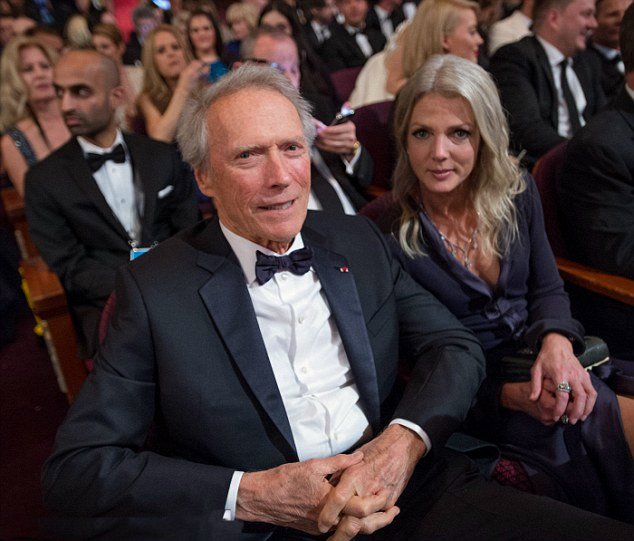
Below: Clint with Bradley Cooper and friend Christina Sandera at the 87th Annual Academy Awards 2015.